
Vibration Monitoring During Sheet Piling: Vibrating, Pressing or Driving
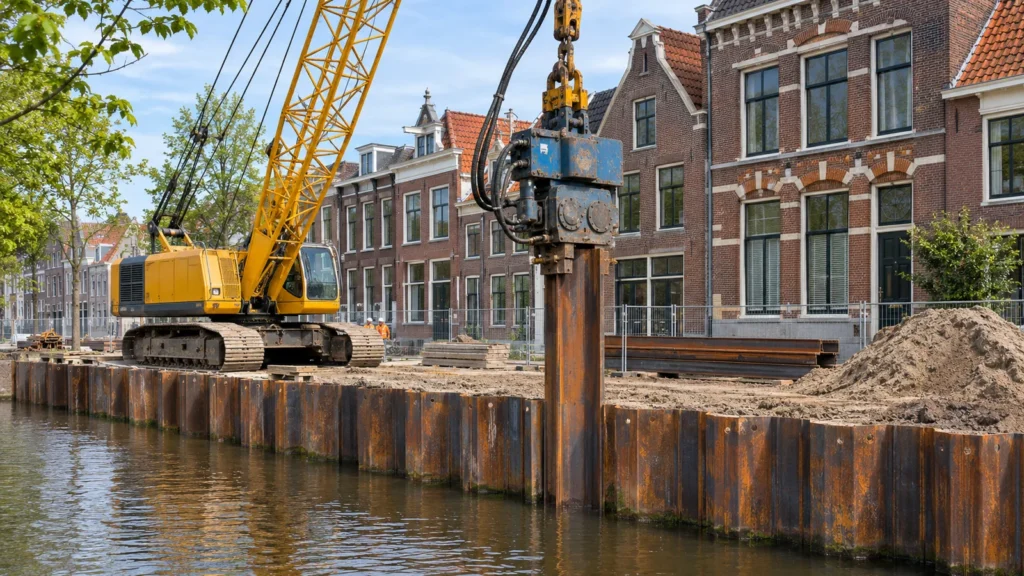
Sheet pile walls are often installed where space is tight: along a quay, around an excavation in a city centre, next to a road or railway. That is exactly where buildings, pipelines and other sensitive objects are close by. Installing and extracting sheet piles can cause vibrations in the ground, and how much depends strongly on the method.
This article explains the differences between vibrating, driving and pressing, the two risks you have to keep an eye on, and how vibration monitoring helps the project team to adjust the work in time.
Three ways to install sheet piles, three vibration patterns
Not every sheet piling job produces the same vibration. The installation method largely determines what the surroundings notice.
| Method | Vibration | Points of attention |
|---|---|---|
| Vibrating (vibratory hammer) | Continuous vibration at the frequency of the vibrator for as long as the sheet pile is moving | Fast and common. Starting and stopping can briefly excite buildings; continuous vibration can compact loose sand |
| Impact driving | Separate pulses with every blow | Used in dense layers. Higher peaks per blow, with a pause in between |
| Pressing | Hardly any vibration | Suitable close to sensitive buildings. Slower, more expensive and not possible in every soil |
Vibrating
Continuous vibration while the sheet pile moves.
Impact driving
A separate pulse with every blow.
Pressing
Hardly any vibration in the ground.
With vibrating, the moments of starting and stopping deserve attention. While the vibrator runs up to its working frequency or slows down, it passes through lower frequencies at which floors and walls of nearby buildings can resonate. Vibrators with a variable moment, often called resonance-free, are designed to avoid this: they only build up force once the working frequency has been reached.
- Run-up: the vibrator passes through the frequencies at which floors and walls resonate.
- Working frequency: above that range.
- Run-down: the same range is passed again.
Extraction counts too. Pulling sheet piles with a vibrator causes vibration in the same way as installing them, and it happens at the end of the project, when attention for the surroundings has often faded.
What determines the vibration level at a building?
- Distance. Vibration decreases with distance, but how quickly depends on the soil.
- Soil. Dense sand layers and obstructions in the ground require more energy, and with it more vibration.
- Sheet pile and machine. The length and profile of the pile, the type of vibrator or hammer and the energy used.
- The building itself. The type of structure, its condition and its foundation determine how sensitive it is, and with that which limit value applies.
Because these factors differ per location, a fixed safe distance does not exist. A vibration forecast before the work and measurements during the work give the answer for your situation.
Two risks: vibration and settlement
The first risk is the vibration itself. Strong vibrations can damage a building, and weaker ones can be a nuisance to the people inside or disturb sensitive equipment. In the Netherlands these three effects are assessed with the SBR guidelines A, B and C.
The second risk is less visible. Continuous vibration can compact loose sand around the sheet pile. The ground surface then drops, and a nearby building on a shallow foundation drops with it. This can happen at vibration levels that stay below the limit for direct damage. Near buildings on shallow foundations in sandy soil, it is therefore worth measuring vibration and also monitoring settlement.
- Vibration travels through the ground to the building.
- Loose sand compacts, the ground surface drops and the building settles with it.
Setting up vibration monitoring for sheet piling
- Determine the question. Do you want to protect a building against damage, limit nuisance for residents or safeguard equipment? The answer determines the guideline and the place of the sensor.
- Record the starting situation. A building survey before the work and a baseline measurement show which cracks and which vibrations were already there.
- Choose the measuring points. Usually the nearest and the most vulnerable buildings, with the sensor fixed to the load-bearing structure on the side of the work.
- Set a warning level below the limit. An alert only helps if there is still room to act.
- Agree who receives the alert and what happens next. The machine operator and the site manager must know what they can change.
- Keep measuring during extraction. The monitoring ends when the last sheet pile is out, not when the wall is in.
What can you do when the vibrations get too high?
Monitoring is only useful if a measured value leads to action. With sheet piling the options are concrete:
- adjusting the frequency or the eccentric moment of the vibrator;
- switching to a resonance-free vibrator;
- pre-drilling or jetting to reduce the resistance in dense layers;
- pressing the sheet piles in the sections closest to buildings;
- moving the work to hours when fewer people are affected, if nuisance is the issue.
Which measure is suitable is up to the contractor and the geotechnical adviser. Real-time measurements show within minutes whether it works.
Monitoring sheet piling with the VIBRA 5+
The VIBRA 5+ from Profound is a compact vibration monitor for construction and infrastructure projects. You prepare the project in the Profound Portal with limits, reports and recipients, fix the monitor with a single screw and switch it on. It connects by itself and starts sending measurements.
During the work the project team receives an alert when a set level is approached. Afterwards a report is available for the client or the authority. Is the job about piles rather than sheet piles? Read vibration monitoring during pile driving.
Frequently asked questions about vibrations from sheet piling
Is pressing sheet piles completely vibration-free?
Pressing itself causes hardly any vibration. Supporting work, such as pre-drilling or transport on site, can still be noticeable. If the sheet piles are later pulled with a vibrator, vibrations occur after all.
Which guideline applies to sheet piling in the Netherlands?
Usually SBR guideline A for possible damage to buildings and SBR guideline B for nuisance to people. Which one is required follows from the permit, the contract and the risk assessment.
At what distance from a building is vibration monitoring needed?
There is no fixed distance. It depends on the method, the soil and the building. A vibration forecast made before the work shows whether limits may be approached and where measurements are needed.
Does a vibration monitor also measure settlement?
No. A vibration monitor measures how strongly a building shakes, not whether it has sunk. Settlement is measured with separate systems, such as a liquid level settlement system. The differences are explained in building movement monitoring.
Does an alert mean that there is damage?
No. An alert means that a level set in advance has been reached. It is a signal to look at what is happening and, if necessary, to adjust the work.
Sheet piling planned near buildings?
Describe the project and the surroundings. We will show you how the VIBRA 5+ and the Profound Portal can be used for it.