
How to Measure Vibrations: Vibration Meters, Sensors and Units Explained
Pile driving, sheet piling, demolition and heavy traffic all make the ground and nearby buildings vibrate. Whether those vibrations are acceptable is not something you can feel or estimate. You have to measure them, and you have to measure the right quantity at the right place.
This article explains what a vibration meter actually records, which units and sensors are used in construction, where the sensor belongs and how to read the result.
What do you measure when you measure vibrations?
A vibration is a rapid back-and-forth movement around a rest position. That movement can be described in three ways: how far a point moves (displacement), how fast it moves (velocity) and how quickly that speed changes (acceleration). All three describe the same movement, but each is useful for a different question.
For vibrations from construction work, velocity is the standard quantity. Guidelines such as SBR-A and DIN 4150-3 express their limit values in millimetres per second (mm/s), because the velocity of the vibration relates well to the stress it causes in a building. The highest value that occurs is called the peak particle velocity, or PPV.
The second number you need is the frequency in hertz (Hz): the number of vibrations per second. The same velocity is judged differently at 5 Hz than at 50 Hz, because buildings respond more strongly to low frequencies. A velocity without a frequency is therefore only half a measurement. Read more in measuring vibration frequency.
| Quantity | Unit | Typical use |
|---|---|---|
| Displacement | mm or µm | Slow movements, such as the sway of tall structures |
| Velocity | mm/s | Assessing damage to buildings and nuisance from construction work |
| Acceleration | m/s² or g | Shocks and machine vibrations; also the raw signal of many sensors |
| Frequency | Hz | Determines which limit value applies to the measured velocity |
- Peak value: the highest velocity in the signal, in mm/s. This is the PPV.
- Period: the time one full vibration takes. Ten vibrations per second is a frequency of 10 Hz.
How does a vibration meter work?
A vibration meter for construction work, often called a vibration monitor, does four things in a fixed order.
- Sensing. A sensor that is fixed to the building or the ground follows the movement and turns it into an electrical signal. This happens in three directions at once: two horizontal and one vertical.
- Digitising. The signal is sampled many times per second, so that short peaks are not missed.
- Calculating. For each direction the meter determines the peak velocity and the dominant frequency in every measuring interval.
- Comparing and reporting. The values are compared with the limit that has been set for the project. The meter stores the results. An online system also sends them on and raises an alert when a set level is reached.
The result is not one number but a series: per interval and per direction, a velocity with its frequency. That series shows when the highest values occurred and which activity on site they belong to.
Which sensor is inside a vibration meter?
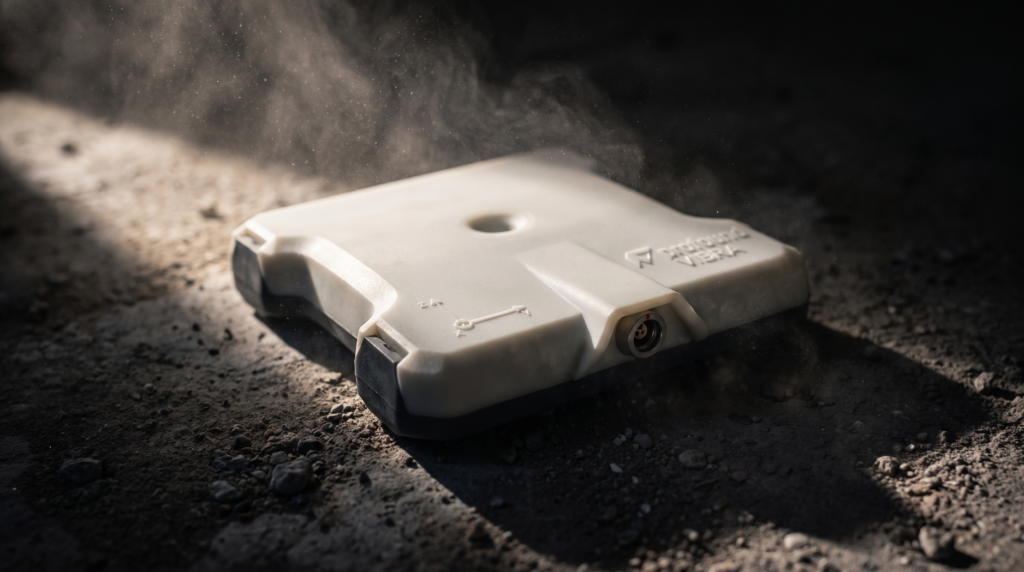
Vibration meters for construction use either a geophone, which produces a signal proportional to velocity, or a MEMS accelerometer, a small chip that measures acceleration from which the meter calculates the velocity. The Profound VIBRA 5+ uses MEMS technology.
Which type is inside matters less than whether the meter covers the frequency range of your project and whether the assessment follows the guideline you have to report against. The two sensor types are compared in how vibration frequency is measured.
Where do you place the sensor?
The location follows from the question. A meter next to the piling rig tells you something about the source, not about the building you want to protect.
- Damage to a building: on a stiff part of the load-bearing structure, such as the foundation or a load-bearing wall, on the side facing the work.
- Nuisance to people: on the floor of the room where people live or work, because that is where they feel the vibration.
- Sensitive equipment: at the place where the equipment stands.
- Damage: on the foundation or a load-bearing wall, on the side of the work.
- Nuisance: on the floor of the room where people are.
- Equipment: next to the sensitive equipment.
The applicable guideline prescribes the exact position. In the Netherlands these are the SBR guidelines A, B and C; in Germany and on many international projects DIN 4150-3 is used.
Just as important is the fixing. The sensor must move with the structure, so it is screwed or glued to a hard surface. A meter that stands loose on a carpet, a loose tile or a window sill mainly measures its own movement. The VIBRA 5+ is fixed with a single screw or a mounting plate.
How do you read the results?
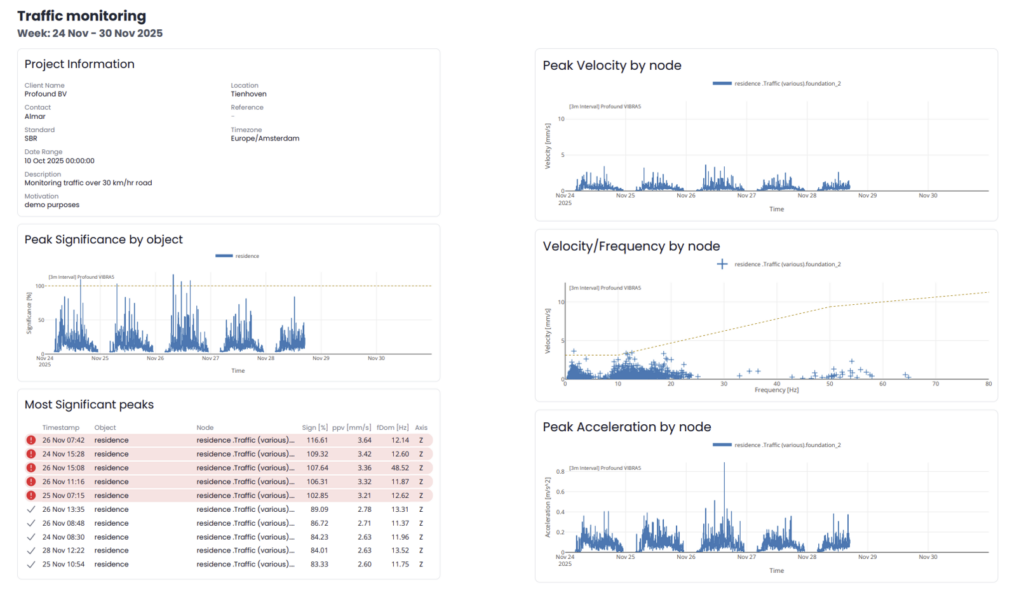
A measured value only means something next to a limit value. That limit depends on three things: the frequency, the type of building and the kind of vibration (short and occasional, or continuous).
An example: 3 mm/s at the foundation of a modern concrete office building is usually no reason for concern. The same 3 mm/s at a low frequency on a historic masonry building can be at or above the limit. That is why one fixed alarm level for every project is a common mistake.
For nuisance the approach is different. Guidelines such as SBR-B do not look at a single peak but at a weighted vibration level over a period, which better reflects what people experience.
A single measurement or continuous monitoring?
A short measurement answers a one-off question: how strong are the vibrations from this machine at this spot, today? That is useful for a trial or to check a complaint.
Construction work changes from day to day. The rig moves closer, the soil differs per pile, a different machine arrives. For that reason vibrations during piling, sheet piling and demolition are usually monitored continuously, with alerts that reach the project team while the work is still going on. More about this in what is vibration monitoring.
Not the same thing: vibration meters for machines
Search for a vibration meter and you will also find handheld instruments for pumps, motors and bearings. They measure vibration on the machine itself to detect wear, usually as an average (RMS) velocity according to machine standards such as ISO 20816.
That is a different job with different requirements. For construction and infrastructure projects you need a meter that measures in three directions, records peak values together with their frequency and assesses them against the guidelines for buildings.
What to look for in a vibration meter for construction
- Three measuring directions, with velocity and frequency per direction.
- A frequency range that includes low frequencies, where the limits for buildings are strictest.
- Assessment and reporting according to the guideline you work with, such as SBR or DIN 4150-3.
- Alerts in real time, so that the work can be adjusted before a limit is exceeded.
- Enough battery life and a simple way of mounting, so that the meter can stay in place unattended.
- Reports that a client, an authority or a resident can understand.
The VIBRA 5+ was developed for this work. It is fixed with a single screw, connects to the Profound Portal by itself, runs for up to 180 hours on its internal battery and sends alerts when set levels are approached. Limits, recipients and reports are set up in the portal beforehand.
Frequently asked questions about measuring vibrations
In which unit are vibrations measured?
For construction work, in millimetres per second (mm/s) for the velocity and hertz (Hz) for the frequency. Displacement is given in millimetres or micrometres, acceleration in m/s² or g.
What is PPV?
PPV stands for peak particle velocity: the highest velocity that occurs at the measuring point during a vibration, in mm/s. Most guidelines for buildings compare this value with their limits.
Can I measure vibrations with a smartphone?
A phone contains an accelerometer, and an app can show that something is vibrating. It is not a measurement you can assess against a guideline: the sensor is not calibrated for this purpose, the phone is not fixed to the structure, and the frequency range and accuracy are unknown.
What is the difference between a vibration meter and a vibration monitor?
The terms are used interchangeably. A vibration monitor usually means a meter that stays on site, measures continuously and passes on results and alerts by itself.
How long should vibrations be measured?
As long as the work that causes them is going on near the object you want to protect. A baseline measurement before the work starts shows which vibrations, from traffic for example, were already there.
Need advice on measuring vibrations on your project?
Tell us what is being built, what stands next to it and what you have to report. We will look at which measuring set-up fits.